Selasa, 01 Januari 2013

[Z636.Ebook] Get Free Ebook Winter of the World: Book Two of the Century Trilogy, by Ken Follett

Get Free Ebook Winter of the World: Book Two of the Century Trilogy, by Ken Follett

Downloading the book Winter Of The World: Book Two Of The Century Trilogy, By Ken Follett in this website listings can provide you more benefits. It will certainly show you the most effective book collections as well as completed collections. Many books can be discovered in this internet site. So, this is not just this Winter Of The World: Book Two Of The Century Trilogy, By Ken Follett However, this publication is referred to read because it is a motivating publication to offer you a lot more opportunity to obtain experiences and also thoughts. This is easy, read the soft file of the book Winter Of The World: Book Two Of The Century Trilogy, By Ken Follett and you get it.
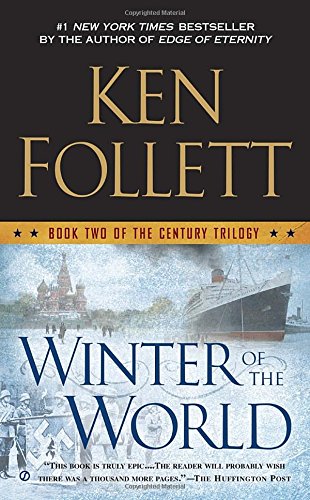
Winter of the World: Book Two of the Century Trilogy, by Ken Follett

Winter of the World: Book Two of the Century Trilogy, by Ken Follett


Winter of the World: Book Two of the Century Trilogy, by Ken Follett

Get Free Ebook Winter of the World: Book Two of the Century Trilogy, by Ken Follett

Winter Of The World: Book Two Of The Century Trilogy, By Ken Follett. Someday, you will find a brand-new adventure as well as understanding by spending more money. However when? Do you believe that you have to acquire those all demands when having significantly cash? Why do not you aim to get something simple at initial? That's something that will lead you to know more about the world, experience, some locations, past history, amusement, and also a lot more? It is your very own time to proceed checking out habit. Among the books you could delight in now is Winter Of The World: Book Two Of The Century Trilogy, By Ken Follett right here.

Also the price of a book Winter Of The World: Book Two Of The Century Trilogy, By Ken Follett is so affordable; several individuals are actually thrifty to reserve their money to purchase the books. The various other reasons are that they feel bad and have no time to visit the e-book establishment to look guide Winter Of The World: Book Two Of The Century Trilogy, By Ken Follett to read. Well, this is modern-day period; many publications can be obtained conveniently. As this Winter Of The World: Book Two Of The Century Trilogy, By Ken Follett and also much more publications, they can be got in quite fast methods. You will certainly not have to go outdoors to get this publication Winter Of The World: Book Two Of The Century Trilogy, By Ken Follett

By seeing this web page, you have done the right staring factor. This is your begin to choose the e-book Winter Of The World: Book Two Of The Century Trilogy, By Ken Follett that you want. There are lots of referred publications to read. When you intend to get this Winter Of The World: Book Two Of The Century Trilogy, By Ken Follett as your book reading, you could click the link web page to download and install Winter Of The World: Book Two Of The Century Trilogy, By Ken Follett In few time, you have actually owned your referred books as all yours.

Due to this book Winter Of The World: Book Two Of The Century Trilogy, By Ken Follett is offered by on the internet, it will certainly ease you not to print it. you can get the soft file of this Winter Of The World: Book Two Of The Century Trilogy, By Ken Follett to save in your computer, gizmo, and a lot more devices. It depends upon your willingness where and also where you will review Winter Of The World: Book Two Of The Century Trilogy, By Ken Follett One that you need to consistently remember is that reviewing book Winter Of The World: Book Two Of The Century Trilogy, By Ken Follett will never end. You will have eager to check out various other publication after completing an e-book, as well as it's continuously.

Winter of the World: Book Two of the Century Trilogy, by Ken Follett

"This book is truly epic. . . . The reader will probably wish there was a thousand more pages." —The Huffington Post

Picking up where Fall of Giants, the first novel in the extraordinary Century Trilogy, left off, Winter of the World follows its five interrelated families—American, German, Russian, English, and Welsh—through a time of enormous social, political, and economic turmoil, beginning with the rise of the Third Reich, through the great dramas of World War II, and into the beginning of the long Cold War.

Carla von Ulrich, born of German and English parents, finds her life engulfed by the Nazi tide until daring to commit a deed of great courage and heartbreak . . . . American brothers Woody and Chuck Dewar, each with a secret, take separate paths to momentous events, one in Washington, the other in the bloody jungles of the Pacific . . . . English student Lloyd Williams discovers in the crucible of the Spanish Civil War that he must fight Communism just as hard as Fascism . . . . Daisy Peshkov, a driven social climber, cares only for popularity and the fast set until war transforms her life, while her cousin Volodya carves out a position in Soviet intelligence that will affect not only this war but also the war to come.

  • Sales Rank: #6592 in Books
  • Published on: 2014-08-26
  • Released on: 2014-08-26
  • Original language: English
  • Number of items: 1
  • Dimensions: 6.75" h x 1.13" w x 4.13" l, 1.00 pounds
  • Binding: Mass Market Paperback
  • 928 pages

Review
Praise for Winter of the World

"Gripping . . . powerful." —The New York Times

"Some of the biggest-picture fiction being written today." —The Seattle Times

"A consistently compelling portrait of a world in crisis." —The Washington Post  

"Masterfully sweeping. . . . Political intrigue, amorous episodes, suspense, and drama. History comes to life." —The Louisville Courier-Journal

"[Follett] is so good at plotting a story, even one that takes on such a complex topic such as the World War II era. That's what makes Winter of the World so hard to put down. You want to know what happens next." —The Associated Press

"An entertaining historical soap opera." —Kirkus Reviews

"The man tells a story so well. . . . Follett can make things glow with some beautifully written episodes." —St. Louis Post-Dispatch

"Clips along at a brisk pace. . . [Follett] knows how to keep the pages turning and how to make the reader feel a kinship with the characters' struggles. . . . No matter the ultimate destination, readers can expect to savor the journey." —The Christian Science Monitor

About the Author
Ken Follett is one of the world’s best-loved authors, selling more than 160 million copies of his thirty books. Follett’s first bestseller was Eye of the Needle, a spy story set in the Second World War. 
 
In 1989 The Pillars of the Earth was published, and has since become the author's most successful novel. It reached number one on bestseller lists around the world and was an Oprah’s Book Club pick.
 
Its sequel, World Without End, proved equally popular, and the Kingsbridge series has sold 38 million copies worldwide. The third book, A Column of Fire, will be published by Viking in Fall 2017.
 
Follett lives in Hertfordshire, England, with his wife Barbara. Between them they have five children, six grandchildren, and three Labradors. 

Excerpt. © Reprinted by permission. All rights reserved.
Chapter One


1933


Carla knew her parents were about to have a row. The second she walked into the kitchen she felt the hostility, like the bone-deep cold of the wind that blew through the streets of Berlin before a February snowstorm. She almost turned and walked back out again.

It was unusual for them to fight. Mostly they were affectionate—too much so. Carla cringed when they kissed in front of other people. Her friends thought it was strange: their parents did not do that. She had said that to her mother, once. Mother had laughed in a pleased way and said: “The day after our wedding, your father and I were separated by the Great War.” She had been born English, though you could hardly tell. “I stayed in London while he came home to Germany and joined the army.” Carla had heard this story many times, but Mother never tired of telling it. “We thought the war would last three months, but I didn’t see him again for five years. All that time I longed to touch him. Now I never tire of it.”

Father was just as bad. “Your mother is the cleverest woman I ever met,” he had said here in the kitchen just a few days ago. “That’s why I married her. It had nothing to do with . . .” He had trailed off, and Mother and he had giggled conspiratorially, as if Carla at the age of eleven knew nothing about sex. It was so embarrassing.

But once in a while they had a quarrel. Carla knew the signs. And a new one was about to erupt.

They were sitting at opposite ends of the kitchen table. Father was somberly dressed in a dark gray suit, starched white shirt, and black satin tie. He looked dapper, as always, even though his hair was receding and his waistcoat bulged a little beneath the gold watch chain. His face was frozen in an expression of false calm. Carla knew that look. He wore it when one of the family had done something that angered him.

He held in his hand a copy of the weekly magazine for which Mother worked, The Democrat. She wrote a column of political and diplomatic gossip under the name of Lady Maud. Father began to read aloud. “‘ ‘Our new chancellor, Herr Adolf Hitler, made his debut in diplomatic society at President Hindenburg’s reception.’”

The president was the head of state, Carla knew. He was elected, but he stood above the squabbles of day-to-day politics, acting as referee. The chancellor was the premier. Although Hitler had been made chancellor, his Nazi Party did not have an overall majority in the Reichstag—the German parliament—so, for the present, the other parties could restrain Nazi excesses.

Father spoke with distaste, as if forced to mention something repellent, like sewage. “ ‘He looked uncomfortable in a formal tailcoat.’ ”

Carla’s mother sipped her coffee and looked out of the window to the street, as if interested in the people hurrying to work in scarves and gloves. She, too, was pretending to be calm, but Carla knew she was just waiting for her moment.

The maid, Ada, was standing at the counter in an apron, slicing cheese. She put a plate in front of Father, but he ignored it. “ ‘Herr Hitler was evidently charmed by Elisabeth Cerruti, the cultured wife of the Italian ambassador, in a rose-pink velvet gown trimmed with sable.’ ”

Mother always wrote about what people were wearing. She said it helped the reader picture them. She herself had fine clothes, but times were hard and she had not bought anything new for years. This morning she looked slim and elegant in a navy blue cashmere dress that was probably as old as Carla.

“ ‘Signora Cerruti, who is Jewish, is a passionate Fascist, and they talked for many minutes. Did she beg Hitler to stop whipping up hatred of Jews?’” Father put the magazine down on the table with a slap.

Here it comes, Carla thought.

“You realize that will infuriate the Nazis,” he said.

“I hope so,” Mother said coolly. “The day they’re pleased with what I write, I shall give it up.”

“They’re dangerous when riled.”

Mother’s eyes flashed anger. “Don’t you dare condescend to me, Walter. I know they’re dangerous—that’s why I oppose them.”

“I just don’t see the point of making them irate.”

“You attack them in the Reichstag.” Father was an elected parliamentary representative for the Social Democratic Party.

“I take part in a reasoned debate.”

This is typical, Carla thought. Father was logical, cautious, law-abiding. Mother had style and humor. He got his way by quiet persistence, she with charm and cheek. They would never agree.

Father added: “I don’t drive the Nazis mad with fury.”

“Perhaps that’s because you don’t do them much harm.”

Father was irritated by her quick wit. His voice became louder. “And you think you damage them with jokes?”

“I mock them.”

“And that’s your substitute for argument.”

“I believe we need both.”

Father became angrier. “But, Maud, don’t you see how you’re putting yourself and your family at risk?”

“On the contrary. The real danger is not to mock the Nazis. What would life be like for our children if Germany became a Fascist state?”

This kind of talk made Carla feel queasy. She could not bear to hear that the family was in danger. Life must go on as it always had. She wished she could sit in this kitchen for an eternity of mornings, with her parents at opposite ends of the pine table, Ada at the counter, and her brother, Erik, thumping around upstairs, late again. Why should anything change?

She had listened to political talk every breakfast-time of her life and she thought she understood what her parents did, and how they planned to make Germany a better place for everyone. But lately they had begun to talk in a different way. They seemed to think that a terrible danger loomed, but Carla could not quite imagine what it was.

Father said: “God knows I’m doing everything I can to hold back Hitler and his mob.”

“And so am I. But, when you do it, you believe you’re following a sensible course.” Mother’s face hardened in resentment. “And when I do it I’m accused of putting the family at risk.”

“And with good reason,” said Father. The row was only just getting started, but at that moment Erik came down, clattering like a horse on the stairs, and lurched into the kitchen with his school satchel swinging from his shoulder. He was thirteen, two years older than Carla, and there were unsightly black hairs sprouting from his upper lip. When they were small, Carla and Erik had played together all the time; but those days were over, and since he had grown so tall he had pretended to think she was stupid and childish. In fact she was smarter than he, and knew about a lot of things he did not understand, such as women’s monthly cycles.

“What was that last tune you were playing?” he said to Mother.

The piano often woke them in the morning. It was a Steinway grand—inherited, like the house itself, from Father’s parents. Mother played in the morning because, she said, she was too busy the rest of the day and too tired in the evening. This morning she had performed a Mozart sonata, then a jazz tune. “It’s called ‘Tiger Rag,’” she told Erik. “Do you want some cheese?”

“Jazz is decadent,” Erik said.

“Don’t be silly.”

Ada handed Erik a plate of cheese and sliced sausage, and he began to shovel it in. Carla thought his manners were dreadful.

Father looked severe. “Who’s been teaching you this nonsense, Erik?”

“Hermann Braun says that jazz isn’t music, just Negroes making a noise.” Hermann was Erik’s best friend; his father was a member of the Nazi Party.

“Hermann should try to play it.” Father looked at Mother, and his face softened. She smiled at him. He went on: “Your mother tried to teach me ragtime, many years ago, but I couldn’t master the rhythm.”

Mother laughed. “It was like trying to get a giraffe to roller-skate.”

The fight was over, Carla saw with relief. She began to feel better. She took some black bread and dipped it in milk.

But now Erik wanted an argument. “Negroes are an inferior race,” he said defiantly.

“I doubt that,” Father said patiently. “If a Negro boy were brought up in a nice house full of books and paintings, and sent to an expensive school with good teachers, he might turn out to be smarter than you.”

“That’s ridiculous!” Erik protested.

Mother put in: “Don’t call your father ridiculous, you foolish boy.” Her tone was mild: she had used up her anger on Father. Now she just sounded wearily disappointed. “You don’t know what you’re talking about, and neither does Hermann Braun.”

Erik said: “But the Aryan race must be superior—we rule the world!”

“Your Nazi friends don’t know any history,” Father said. “The Ancient Egyptians built the pyramids when Germans were living in caves. Arabs ruled the world in the Middle Ages—the Muslims were doing algebra when German princes could not write their own names. It’s nothing to do with race.”

Carla frowned and said: “What is it to do with, then?”

Father looked at her fondly. “That’s a very good question, and you’re a bright girl to ask it.” She glowed with pleasure at his praise. “Civilizations rise and fall—the Chinese, the Aztecs, the Romans—but no one really knows why.”

“Eat up, everyone, and put your coats on,” Mother said. “It’s getting late.”

Father pulled his watch out of his waistcoat pocket and looked at it with raised eyebrows. “It’s not late.”

“I’ve got to take Carla to the Francks’ house,” Mother said. “The girls’ school is closed for a day—something about repairing the furnace—so Carla’s going to spend today with Frieda.”

Frieda Franck was Carla’s best friend. Their mothers were best friends, too. In fact, when they were young, Frieda’s mother, Monika, had been in love with Father—a hilarious fact that Frieda’s grandmother had revealed one day after drinking too much Sekt.

Father said: “Why can’t Ada look after Carla?”

“Ada has an appointment with the doctor.”

“Ah.”

Carla expected Father to ask what was wrong with Ada, but he nodded as if he already knew, and put his watch away. Carla wanted to ask, but something told her she should not. She made a mental note to ask Mother later. Then she immediately forgot about it.

Father left first, wearing a long black overcoat. Then Erik put on his cap—perching it as far back on his head as it would go without falling off, as was the fashion among his friends—and followed Father out of the door.

Carla and her mother helped Ada clear the table. Carla loved Ada almost as much as she loved her mother. When Carla was little, Ada had taken care of her full-time, until she was old enough to go to school, for Mother had always worked. Ada was not married yet. She was twenty-nine and homely-looking, though she had a lovely kind smile. Last summer she had had a romance with a policeman, Paul Huber, but it had not lasted.

Carla and her mother stood in front of the mirror in the hall and put on their hats. Mother took her time. She chose a dark blue felt, with a round crown and a narrow brim, the type all the women were wearing, but she tilted hers at a different angle, making it look chic. As Carla put on her knitted wool cap, she wondered whether she would ever have Mother’s sense of style. Mother looked like a goddess of war, her long neck and chin and cheekbones carved out of white marble; beautiful, yes, but definitely not pretty. Carla had the same dark hair and green eyes, but looked more like a plump doll than a statue. Carla had once accidentally overheard her grandmother say to Mother: “Your ugly duckling will grow into a swan, you’ll see.” Carla was still waiting for it to happen.

When Mother was ready, they went out. Their home stood in a row of tall, gracious town houses in the Mitte district, the old center of the city, built for high-ranking ministers and army officers such as Carla’s grandfather, who had worked at the nearby government buildings.

Carla and her mother rode a tram along Unter den Linden, then took the S train from Friedrich Strasse to the Zoo Station. The Francks lived in the southwestern suburb of Schöneberg.

Carla was hoping to see Frieda’s brother Werner, who was fourteen. She liked him. Sometimes Carla and Frieda imagined they each married the other’s brother, and were next-door neighbors, and their children were best friends. It was just a game to Frieda, but Carla was secretly serious. Werner was handsome and grown-up and not a bit silly like Erik. In the dollhouse in Carla’s bedroom, the mother and father sleeping side by side in the miniature double bed were called Carla and Werner, but no one knew that, not even Frieda.

Frieda had another brother, Axel, seven, but he had been born with spina bifida, and had to have constant medical care. He lived in a special hospital on the outskirts of Berlin.

Mother was preoccupied on the journey. “I hope this is going to be all right,” she muttered, half to herself, as they got off the train.

“Of course it will,” Carla said. “I’ll have a lovely time with Frieda.”

“I didn’t mean that. I’m talking about my paragraph about Hitler.”

“Are we in danger? Was Father right?”

“Your father is usually right.”

“What will happen to us if we’ve annoyed the Nazis?”

Mother stared at her strangely for a long moment, then said: “Dear God, what kind of a world did I bring you into?” Then she went quiet.

After a ten-minute walk they arrived at a grand villa in a big garden. The Francks were rich: Frieda’s father, Ludwig, owned a factory making radio sets. Two cars stood in the driveway. The large shiny black one belonged to Herr Franck. The engine rumbled, and a cloud of blue vapor rose from the tailpipe. The chauffeur, Ritter, with uniform trousers tucked into high boots, stood cap in hand ready to open the door. He bowed and said: “Good morning, Frau von Ulrich.”

The second car was a little green two-seater. A short man with a gray beard came out of the house carrying a leather case, and touched his hat to Mother as he got into the small car. “I wonder what Dr. Rothmann is doing here so early in the morning,” Mother said anxiously.

They soon found out. Frieda’s mother, Monika, came to the door, a tall woman with a mass of red hair. Anxiety showed on her pale face. Instead of welcoming them in, she stood squarely in the doorway as if to bar their entrance. “Frieda has measles!” she said.

“I’m so sorry!” said Mother. “How is she?”

“Miserable. She has a fever and a cough. But Rothmann says she’ll be all right. However, she’s quarantined.”

“Of course. Have you had it?”

“Yes—when I was a girl.”

“And Werner has, too—I remember he had a terrible rash all over. But what about your husband?” Mother asked.

“Ludi had it as a boy.”

Both women looked at Carla. She had never had measles. She realized this meant she could not spend the day with Frieda.

Carla was disappointed, but Mother was quite shaken. “This week’s magazine is our election issue—I can’t be absent.” She looked distraught. All the grown-ups were apprehensive about the general election to be held next Sunday. Mother and Father both feared the Nazis might do well enough to take full control of the government. “Plus my oldest friend is visiting from London. I wonder whether Walter could be persuaded to take a day off to look after Carla?”

Monika said: “Why don’t you telephone him?”

Not many people had phones in their homes, but the Francks did, and Carla and her mother stepped into the hall. The instrument stood on a spindly-legged table near the door. Mother picked it up and gave the number of Father’s office at the Reichstag, the parliament building. She got through to him and explained the situation. She listened for a minute, then looked angry. “My magazine will urge a hundred thousand readers to campaign for the Social Democratic Party,” she said. “Do you really have something more important than that to do today?”

Carla could guess how this argument would end. Father loved her dearly, she knew, but in all her eleven years he had never looked after her for a whole day. All her friends’ fathers were the same. Men did not do that sort of thing. But Mother sometimes pretended not to know the rules women lived by.

“I’ll just have to take her to the office with me, then,” Mother said into the phone. “I dread to think what Jochmann will say.” Herr Jochmann was her boss. “He’s not much of a feminist at the best of times.” She replaced the handset without saying good-bye.

Carla hated it when they fought, and this was the second time in a day. It made the whole world seem unstable. She was much more scared of quarrels than of the Nazis.

“Come on, then,” Mother said to her, and she moved to the door.

I’m not even going to see Werner, Carla thought unhappily.

Just then Frieda’s father appeared in the hall, a pink-faced man with a small black mustache, energetic and cheerful. He greeted Mother pleasantly, and she paused to speak politely to him while Monika helped him into a black topcoat with a fur collar.

He went to the foot of the stairs. “Werner!” he shouted. “I’m going without you!” He put on a gray felt hat and went out.

“I’m ready, I’m ready!” Werner ran down the stairs like a dancer. He was as tall as his father and more handsome, with red-blond hair worn too long. Under his arm he had a leather satchel that appeared to be full of books; in the other hand he held a pair of ice skates and a hockey stick. He paused in his rush to say: “Good morning, Frau von Ulrich,” very politely. Then in a more informal tone: “Hello, Carla. My sister’s got the measles.”

Carla felt herself blush, for no reason at all. “I know,” she said. She tried to think of something charming and amusing to say, but came up with nothing. “I’ve never had it, so I can’t see her.”

“I had it when I was a kid,” he said, as if that was ever such a long time ago. “I must hurry,” he added apologetically.

Carla did not want to lose sight of him so quickly. She followed him outside. Ritter was holding the rear door open. “What kind of car is that?” Carla said. Boys always knew the makes of cars.

“A Mercedes-Benz W10 limousine.”

“It looks very comfortable.” She caught a look from her mother, half surprised and half amused.

Werner said: “Do you want a lift?”

“That would be nice.”

“I’ll ask my father.” Werner put his head inside the car and said something.

Carla heard Herr Franck reply: “Very well, but hurry up!”

She turned to her mother. “We can go in the car!”

Mother hesitated for only a moment. She did not like Herr Franck’s politics—he gave money to the Nazis—but she was not going to refuse a lift in a warm car on a cold morning. “How very kind of you, Ludwig,” she said.

They got in. There was room for four in the back. Ritter pulled away smoothly. “I assume you’re going to Koch Strasse?” said Herr Franck. Many newspapers and book publishers had their offices in the same street in the Kreuzberg district.

“Please don’t go out of your way. Leipziger Strasse would be fine.”

“I’d be happy to take you to the door—but I suppose you don’t want your leftist colleagues to see you getting out of the car of a bloated plutocrat.” His tone was somewhere between humorous and hostile.

Mother gave him a charming smile. “You’re not bloated, Ludi—just a little plump.” She patted the front of his coat.

He laughed. “I asked for that.” The tension eased. Herr Franck picked up the speaking tube and gave instructions to Ritter.

Carla was thrilled to be in a car with Werner, and she wanted to make the most of it by talking to him, but at first she could not think what to speak about. She really wanted to say: “When you’re older, do you think you might marry a girl with dark hair and green eyes, about three years younger than yourself, and clever?” Eventually she pointed to his skates and said: “Do you have a match today?”

“No, just practise after school.”

“What position do you play in?” She knew nothing about ice hockey, but there were always positions in team games.

“Right wing.”

“Isn’t it a rather dangerous sport?”

“Not if you’re quick.”

“You must be ever such a good skater.”

“Not bad,” he said modestly.

Once again Carla caught her mother watching her with an enigmatic little smile. Had she guessed how Carla felt about Werner? Carla felt another blush coming.

Then the car came to a stop outside a school building, and Werner got out. “Good-bye, everyone!” he said, and ran through the gates into the yard.

Ritter drove on, following the south bank of the Landwehr Canal. Carla looked at the barges, their loads of coal topped with snow like mountains. She felt a sense of disappointment. She had contrived to spend longer with Werner, by hinting that she wanted a lift, then she had wasted the time talking about ice hockey.

What would she have liked to talk to him about? She did not know.

Herr Franck said to Mother: “I read your column in The Democrat.”

“I hope you enjoyed it.”

“I was sorry to see you writing disrespectfully about our chancellor.”

“Do you think journalists should write respectfully about politicians?” Mother replied cheerfully. “That’s radical. The Nazi press would have to be polite about my husband! They wouldn’t like that.”

“Not all politicians, obviously,” Franck said irritably.

They crossed the teeming junction of Potsdamer Platz. Cars and trams vied with horse-drawn carts and pedestrians in a chaotic melee.

Mother said: “Isn’t it better for the press to be able to criticize everyone equally?”

“A wonderful idea,” he said. “But you socialists live in a dream world. We practical men know that Germany cannot live on ideas. People must have bread and shoes and coal.”

“I quite agree,” Mother said. “I could use more coal myself. But I want Carla and Erik to grow up as citizens of a free country.”

“You overrate freedom. It doesn’t make people happy. They prefer leadership. I want Werner and Frieda and poor Axel to grow up in a country that is proud, and disciplined, and united.”

“And in order to be united, we need young thugs in brown shirts to beat up elderly Jewish shopkeepers?”

“Politics is rough. Nothing we can do about it.”

“On the contrary. You and I are leaders, Ludwig, in our different ways. It’s our responsibility to make politics less rough—more honest, more rational, less violent. If we do not do that, we fail in our patriotic duty.”

Herr Franck bristled.

Carla did not know much about men, but she realized they did not like to be lectured on their duty by women. Mother must have forgotten to press her charm switch this morning. But everyone was tense. The coming election had them all on edge.

The car reached Leipziger Platz. “Where may I drop you?” Herr Franck said coldly.

“Just here will be fine,” said Mother.

Franck tapped on the glass partition. Ritter stopped the car and hurried to open the door.

Mother said: “I do hope Frieda gets better soon.”

“Thank you.”

They got out and Ritter closed the door.

The office was several minutes’ walk away, but Mother clearly had not wanted to stay any longer in the car. Carla hoped Mother was not going to quarrel permanently with Herr Franck. That might make it difficult for her to see Frieda and Werner. She would hate that.

They set off at a brisk pace. “Try not to make a nuisance of yourself at the office,” Mother said. The note of genuine pleading in her voice touched Carla, making her feel ashamed of causing her mother worry. She resolved to behave perfectly.

Mother greeted several people on the way: she had been writing her column for as long as Carla could remember, and was well known in the press corps. They all called her “Lady Maud” in English.

Near the building in which The Democrat had its office, they saw someone they knew: Sergeant Schwab. He had fought with Father in the Great War, and still wore his hair brutally short in the military style. After the war he had worked as a gardener, first for Carla’s grandfather and later for her father, but he had stolen money from Mother’s purse and Father had sacked him. Now he was wearing the ugly military uniform of the storm troopers, the Brownshirts, who were not soldiers but Nazis who had been given the authority of auxiliary policemen.

Schwab said loudly: “Good morning, Frau von Ulrich!” as if he felt no shame at all about being a thief. He did not even touch his cap.

Mother nodded coldly and walked past him. “I wonder what he’s doing here,” she muttered uneasily as they went inside.

The magazine had the first floor of a modern office building. Carla knew a child would not be welcome, and she hoped they could reach Mother’s office without being seen. But they met Herr Jochmann on the stairs. He was a heavy man with thick spectacles. “What’s this?” he said brusquely, speaking around the cigarette in his mouth. “Are we running a kindergarten now?”

Mother did not react to his rudeness. “I was thinking over your comment the other day,” she said. “About how young people imagine journalism is a glamorous profession, and don’t understand how much hard work is necessary.”

He frowned. “Did I say that? Well, it’s certainly true.”

“So I brought my daughter here to see the reality. I think it will be good for her education, especially if she becomes a writer. She will make a report on the visit to her class. I felt sure you would approve.”

Mother was making this up as she went along, but it sounded convincing, Carla thought. She almost believed it herself. The charm switch had been turned to the On position at last.

Jochmann said: “Don’t you have an important visitor from London coming today?”

“Yes, Ethel Leckwith, but she’s an old friend—she knew Carla as a baby.”

Jochmann was somewhat mollified. “Hmm. Well, we have an editorial meeting in five minutes, as soon as I’ve bought some cigarettes.”

“Carla will get them for you.” Mother turned to her. “There is a tobacconist three doors down. Herr Jochmann likes the Roth-Händle brand.”

“Oh, that will save me a trip.” Jochmann gave Carla a one-mark coin.

Mother said to her: “When you come back, you’ll find me at the top of the stairs, next to the fire alarm.” She turned away and took Jochmann’s arm confidentially. “I thought last week’s issue was possibly our best ever,” she said as they went up.

Carla ran out into the street. Mother had got away with it, using her characteristic mixture of boldness and flirting. She sometimes said: “We women have to deploy every weapon we have.” Thinking about it, Carla realized she had used Mother’s tactics to get a lift from Herr Franck. Perhaps she was like her mother after all. That might be why Mother had given her that curious little smile: she was seeing herself thirty years ago.

There was a queue in the shop. Half the journalists in Berlin seemed to be buying their supplies for the day. At last Carla got a pack of Roth-Händles and returned to the Democrat building. She found the fire alarm easily—it was a big lever fixed to the wall—but Mother was not in her office. No doubt she had gone to that editorial meeting.

Carla walked along the corridor. All the doors were open, and most of the rooms were empty but for a few women who might have been typists and secretaries. At the back of the building, around a corner, was a closed door marked conference room. Carla could hear male voices raised in argument. She tapped on the door, but there was no response. She hesitated, then turned the handle and went in.

The room was full of tobacco smoke. Eight or ten people sat around a long table. Mother was the only woman. They fell silent, apparently surprised, when Carla went up to the head of the table and handed Jochmann the cigarettes and change. Their silence made her think she had done wrong to come in.

But Jochmann just said: “Thank you.”

“You’re welcome, sir,” she said, and for some reason she gave a little bow.

The men laughed. One said: “New assistant, Jochmann?” Then she knew it was all right.

She left the room quickly and returned to Mother’s office. She did not take off her coat—the place was cold. She looked around. On the desk were a phone, a typewriter, and stacks of paper and carbon paper.

Next to the phone was a photograph in a frame, showing Carla and Erik with Father. It had been taken a couple of years ago on a sunny day at the beach by the Wannsee lake, fifteen miles from the center of Berlin. Father was wearing shorts. They were all laughing. That was before Erik started to pretend to be a tough serious man.

The only other picture, hanging on the wall, showed Mother with the Social Democratic hero Friedrich Ebert, who had been the first president of Germany after the war. It had been taken about ten years ago. Carla smiled at Mother’s shapeless, low-waisted dress and boyish haircut; they must have been fashionable at the time.

The bookshelf held social directories, phone books, dictionaries in several languages, and atlases, but nothing to read. In the desk drawer were pencils, several new pairs of formal gloves still wrapped in tissue paper, a packet of sanitary towels, and a notebook with names and phone numbers.

Carla reset the desk calendar to today’s date, Monday, February 27, 1933. Then she put a sheet of paper into the typewriter. She typed her full name, Heike Carla von Ulrich. At the age of five she had announced that she did not like the name Heike and she wanted everyone to use her second name, and somewhat to her surprise her family had complied.

Each key of the typewriter caused a metal rod to rise up and strike the paper through an inky ribbon, printing a letter. When by accident she pressed two keys, the rods got stuck. She tried to prize them apart but she could not. Pressing another key did not help: now there were three jammed rods. She groaned: she was in trouble already.

A noise from the street distracted her. She went to the window. A dozen Brownshirts were marching along the middle of the road, shouting slogans: “Death to all Jews! Jews, go to hell!” Carla could not understand why they got so angry about Jews, who seemed the same as everyone else apart from their religion. She was startled to see Sergeant Schwab at the head of the troop. She had felt sorry for him when he was sacked, for she knew he would find it hard to get another job. There were millions of men looking for jobs in Germany; Father said it was a depression. But Mother had said: “How can we have a man in our house who steals?”

Their chant changed. “Smash Jew papers!” they said in unison. One of them threw something, and a rotten vegetable splashed on the door of a national newspaper. Then, to Carla’s horror, they turned toward the building she was in.

She drew back and peeped around the edge of the window frame, hoping they could not see her. They stopped outside, still chanting. One threw a stone. It hit Carla’s window without breaking it, but all the same she gave a little scream of fear. A moment later one of the typists came in, a young woman in a red beret. “What’s the matter?” she said, then she looked out of the window. “Oh, hell.”

The Brownshirts entered the building, and Carla heard boots on the stairs. She was scared: What were they going to do?

Sergeant Schwab came into Mother’s office. He hesitated, seeing the two females, then seemed to screw up his nerve. He picked up the typewriter and threw it through the window, shattering the glass. Carla and the typist both screamed.

More Brownshirts passed the doorway, shouting their slogans.

Schwab grabbed the typist by the arm and said: “Now, darling, where’s the office safe?”

“In the file room!” she said in a terrified voice.

“Show me.”

“Yes, anything!”

He marched her out of the room.

Carla started to cry, then stopped herself.

She thought of hiding under the desk, but hesitated. She did not want to show them how scared she was. Something inside her wanted to defy them.

But what should she do? She decided to warn Mother.

She stepped to the doorway and looked along the corridor. The Brownshirts were going in and out of the offices but had not reached the far end. Carla did not know whether the people in the conference room could hear the commotion. She ran along the corridor as fast as she could, but a scream stopped her. She looked into a room and saw Schwab shaking the typist with the red beret, yelling: “Where’s the key?”

“I don’t know, I swear I’m telling the truth!” the typist cried.

Carla was outraged. Schwab had no right to treat a woman that way. She shouted: “Leave her alone, Schwab, you thief!”

Schwab looked at her with hatred in his eyes, and suddenly she was ten times more frightened. Then his gaze shifted to someone behind her, and he said: “Get the kid out of the damn way.”

She was picked up from behind. “Are you a little Jew?” said a man’s voice. “You look it, with all that dark hair.”

That terrified her. “I’m not Jewish!” she screamed.

The Brownshirt carried her back along the corridor and put her down in Mother’s office. She stumbled and fell to the floor. “Stay in here,” he said, and he went away.

Carla got to her feet. She was not hurt. The corridor was full of Brownshirts now, and she could not get to her mother. But she had to summon help.

She looked out of the smashed window. A small crowd was gathering on the street. Two policemen stood among the onlookers, chatting. Carla shouted at them: “Help! Help, police!”

They saw her and laughed.

That infuriated her, and anger made her less frightened. She looked outside the office again. Her gaze lit on the fire alarm on the wall. She reached up and grasped the handle.

She hesitated. You were not supposed to sound the alarm unless there was a fire, and a notice on the wall warned of dire penalties.

She pulled the handle anyway.

For a moment nothing happened. Perhaps the mechanism was not working.

Then there came a loud, harsh klaxon sound, rising and falling, that filled the building.

Almost immediately the people from the conference room appeared at the far end of the corridor. Jochmann was first. “What the devil is going on?” he said angrily, shouting over the noise of the alarm.

One of the Brownshirts said: “This Jew Communist rag has insulted our leader, and we’re closing it down.”

“Get out of my office!”

The Brownshirt ignored him and went into a side room. A moment later there was a female scream and a crash that sounded like a steel desk being overturned.

Jochmann turned to one of his staff. “Schneider—call the police immediately!”

Carla knew that would be no good. The police were there already, doing nothing.

Mother pushed through the knot of people and came running along the corridor. “Are you all right?” she cried. She threw her arms around Carla.

Carla did not want to be comforted like a child. Pushing her mother away, she said: “I’m fine, don’t worry.”

Mother looked around. “My typewriter!”

“They threw it through the window.” Carla realized that now she would not get into trouble for jamming the mechanism.

“We must get out of here.” Mother snatched up the desk photo, then took Carla’s hand, and they hurried out of the room.

No one tried to stop them running down the stairs. Ahead of them, a well-built young man who might have been one of the reporters had a Brownshirt in a head lock and was dragging him out of the building. Carla and her mother followed the pair out. Another Brownshirt came up behind them.

The reporter approached the two policemen, still dragging the Brownshirt. “Arrest this man,” he said. “I found him robbing the office. You will find a stolen jar of coffee in his pocket.”

“Release him, please,” said the older of the two policemen.

Reluctantly, the reporter let the Brownshirt go.

The second Brownshirt stood beside his colleague.

“What is your name, sir?” the policeman asked the reporter.

“I am Rudolf Schmidt, chief parliamentary correspondent of The Democrat.”

“Rudolph Schmidt, I am arresting you on a charge of assaulting the police.”

“Don’t be ridiculous. I caught this man stealing!”

The policeman nodded to the two Brownshirts. “Take him to the station house.”

They grabbed Schmidt by the arms. He seemed about to struggle, then changed his mind. “Every detail of this incident will appear in the next edition of The Democrat!” he said.

“There will never be another edition,” the policeman said. “Take him away.”

A fire engine arrived and half a dozen firemen jumped out. Their leader spoke brusquely to the police. “We need to clear the building,” he said.

“Go back to your fire station, there’s no fire,” said the older policeman. “It’s just the storm troopers closing down a Communist magazine.”

“That’s no concern of mine,” the fireman said. “The alarm has been sounded, and our first task is to get everyone out, storm troopers and all. We’ll manage without your help.” He led his men inside.

Carla heard her mother say: “Oh, no!” She turned and saw that Mother was staring at her typewriter, which lay on the pavement where it had fallen. The metal casing had dropped away, exposing the links between keys and rods. The keyboard was twisted out of shape, one end of the roller had become detached, and the bell that sounded for the end of a line lay forlornly on the ground. A typewriter was not a precious object, but Mother looked as if she might cry.

The Brownshirts and the staff of the magazine came out of the building, herded by firemen. Sergeant Schwab was resisting, shouting angrily: “There’s no fire!” The firemen just shoved him on.

Jochmann came out and said to Mother: “They didn’t have time to do much damage—the firemen stopped them. Whoever sounded the alarm did us a great service!”

Carla had been worried that she would be reprimanded for causing a false alarm. Now she realized she had done exactly the right thing.

She took her mother’s hand. That seemed to jerk Mother out of her momentary fit of grief. She wiped her eyes with her sleeve, an unusual act that revealed how badly shaken she was: if Carla had done that she would have been told to use her handkerchief. “What do we do now?” Mother never said that—she always knew what to do next.

Carla became aware of two people standing nearby. She looked up. One was a woman about the same age as Mother, very pretty, with an air of authority. Carla knew her, but could not place her. Beside her was a man young enough to be her son. He was slim, and not very tall, but he looked like a movie star. He had a handsome face that would have been almost too pretty except that his nose was flattened and misshapen. Both newcomers looked shocked, and the young man was white with anger.

The woman spoke first, and she used the English language. “Hello, Maud,” she said, and the voice was distantly familiar to Carla. “Don’t you recognize me?” she went on. “I’m Eth Leckwith, and this is Lloyd.”

Most helpful customer reviews

6 of 6 people found the following review helpful.
This is a good book for its own sake
By Sarah
This is a good book for its own sake, but the main thing is that it's an enjoyable way to learn about history in excellent detail through fiction. If you are writing a doctoral thesis on world war 2 politics and history, it's probably not detailed and accurate enough, but if you're just a normal person who hasn't read anything like this since high school or a first year college survey of American history class. Almost no other writer takes you through a story with as much historical detail as Follett, so that you feel like you have been taught a proper lesson along with it. Personally I really enjoy this type of thing and it's my idea of a good time, so this is exactly the type of book I take to the beach. I am a very weird person though, and not a lot of fun at parties. If you are a normal person who has normal person interests, this isn't necessarily the lightest and easiest read. It's long, it's full of facts and details, but those are also its main selling points. If you want something to read in a day with the TV on in the background, or is a quick fix, this is a bad choice. It does have deep interesting characters who develop not only through the first book that preceded this one, but through this book and the third book in the series, action and tragedy, and a wealth of historical information that has a great deal of value beyond the enjoyment of the fictional aspects of the story. I highly recommend this whole series to anyone who enjoys historical fiction.

3 of 3 people found the following review helpful.
History and fiction blend comfortably
By Myra Bosch
I couldn't put the book down. Several fictional plots are drawn amidst a well defined historical background - fictional characters sometimes meeting, or even working with well-known historical figures, thus highlighting some lesser-known characteristics of and facts about them. As this is the second book of Ken Follett's trilogy, many of the characters were either introduced in his first book, Fall of the Giants, or are the offspring of those characters.The story takes place before, during and after World War II and the main characters play out in Germany, Britain, the USA and the Soviet Union. Circumstances, historic, or otherwise, force these characters to gravitate towards each other and the reader senses that they are connected somehow and will inevitably meet.
The novel covers a wide range of world events; the rise of Nazism, the ascent of Franco in Spain, the Battle of Moscow, the Blitz, the Normandy landings, the attack on Pearl Harbor, the development of the atom bomb, the fall of Berlin and many more. This was a fun way of brushing up on my history.

1 of 1 people found the following review helpful.
A good story ruined by bad writing
By Joy
Several of the problems I found in this book have been well-described by others: two-dimensional characters, sanitizing the prejudices of the times with cultural anachronisms, and plot contrivances that defy all efforts to susbend disbelief. Good stories have events service the characters. In this book, the characters only exist to service events. With the exception of Daisy, none of the second generation characters grab my interest as much as the the characters from the first book.

All of the "good guys" have tolerant, 21st century attitudes towards blacks, Jews, homosexuals, and sex. It seems that with every new book Mr. Follett's anachronisms have gotten worse and worse. I began to notice them in Pillars of the Earth, but by the time the modern-thinking, twelfth century, yuppie power-couple in World Without End started spouting psychobabble about their daughter's low self-esteem, I'd had enough. Somehow I hoped this trilogy would be better. I'll have to go back and re-read Eye of the Needle and Triple to see if they were as bad. If they were, then my tastes have changed.

But the worst annoyance for me is that Mr. Follet insists on explaining his characters' every reaction and line of dialog, as if we're not smart enough to understand what they're thinking without dumbing it down for us. It ruins the flow and bugs the heck out of me. A good writer develops his characters so well that we understand the feelings, perspectives and motivations behind their dialog, without having them re-explained after every sentence. It's like explaining the punchline of a joke: If you have to do that, then you didn't tell it right.

I greatly admire Mr. Follet's attention to detail and all the work that must have gone into this book, but it reads like it was written by an amateur romance novelist. For good "you are there" historical fiction, I much prefer Herman Wouk's "The Winds of War."

See all 7047 customer reviews...

Winter of the World: Book Two of the Century Trilogy, by Ken Follett PDF
Winter of the World: Book Two of the Century Trilogy, by Ken Follett EPub
Winter of the World: Book Two of the Century Trilogy, by Ken Follett Doc
Winter of the World: Book Two of the Century Trilogy, by Ken Follett iBooks
Winter of the World: Book Two of the Century Trilogy, by Ken Follett rtf
Winter of the World: Book Two of the Century Trilogy, by Ken Follett Mobipocket
Winter of the World: Book Two of the Century Trilogy, by Ken Follett Kindle

Winter of the World: Book Two of the Century Trilogy, by Ken Follett PDF

Winter of the World: Book Two of the Century Trilogy, by Ken Follett PDF

Winter of the World: Book Two of the Century Trilogy, by Ken Follett PDF

Senin, 24 Desember 2012

[T713.Ebook] PDF Download Escape from the Aliens in Outer Space: Ultimate Edition (Osprey Games), by Santa Ragione

PDF Download Escape from the Aliens in Outer Space: Ultimate Edition (Osprey Games), by Santa Ragione

Some people may be giggling when checking out you reviewing Escape From The Aliens In Outer Space: Ultimate Edition (Osprey Games), By Santa Ragione in your leisure. Some could be admired of you. And also some may want resemble you which have reading pastime. Just what about your own feeling? Have you really felt right? Checking out Escape From The Aliens In Outer Space: Ultimate Edition (Osprey Games), By Santa Ragione is a need and a pastime simultaneously. This problem is the on that particular will certainly make you feel that you must review. If you understand are trying to find the book qualified Escape From The Aliens In Outer Space: Ultimate Edition (Osprey Games), By Santa Ragione as the choice of reading, you can locate below.

Escape from the Aliens in Outer Space: Ultimate Edition (Osprey Games), by Santa Ragione

Escape from the Aliens in Outer Space: Ultimate Edition (Osprey Games), by Santa Ragione


Escape from the Aliens in Outer Space: Ultimate Edition (Osprey Games), by Santa Ragione

PDF Download Escape from the Aliens in Outer Space: Ultimate Edition (Osprey Games), by Santa Ragione

Why must choose the problem one if there is easy? Get the profit by getting the book Escape From The Aliens In Outer Space: Ultimate Edition (Osprey Games), By Santa Ragione below. You will certainly obtain different means to make an offer and get guide Escape From The Aliens In Outer Space: Ultimate Edition (Osprey Games), By Santa Ragione As understood, nowadays. Soft data of the books Escape From The Aliens In Outer Space: Ultimate Edition (Osprey Games), By Santa Ragione come to be preferred among the viewers. Are you among them? And also right here, we are supplying you the extra collection of ours, the Escape From The Aliens In Outer Space: Ultimate Edition (Osprey Games), By Santa Ragione.

The benefits to take for reading guides Escape From The Aliens In Outer Space: Ultimate Edition (Osprey Games), By Santa Ragione are involving boost your life high quality. The life quality will not only concerning exactly how significantly knowledge you will get. Even you read the enjoyable or entertaining e-books, it will certainly aid you to have improving life high quality. Feeling enjoyable will certainly lead you to do something perfectly. Moreover, guide Escape From The Aliens In Outer Space: Ultimate Edition (Osprey Games), By Santa Ragione will offer you the lesson to take as a great factor to do something. You could not be pointless when reviewing this e-book Escape From The Aliens In Outer Space: Ultimate Edition (Osprey Games), By Santa Ragione

Never mind if you do not have adequate time to visit guide store as well as look for the favourite book to read. Nowadays, the on the internet e-book Escape From The Aliens In Outer Space: Ultimate Edition (Osprey Games), By Santa Ragione is pertaining to offer ease of reviewing practice. You could not have to go outdoors to search guide Escape From The Aliens In Outer Space: Ultimate Edition (Osprey Games), By Santa Ragione Searching and downloading and install the book qualify Escape From The Aliens In Outer Space: Ultimate Edition (Osprey Games), By Santa Ragione in this short article will offer you better option. Yeah, on the internet e-book Escape From The Aliens In Outer Space: Ultimate Edition (Osprey Games), By Santa Ragione is a sort of digital book that you could enter the web link download given.

Why need to be this on the internet e-book Escape From The Aliens In Outer Space: Ultimate Edition (Osprey Games), By Santa Ragione You could not have to go somewhere to review the publications. You can read this publication Escape From The Aliens In Outer Space: Ultimate Edition (Osprey Games), By Santa Ragione each time and every where you really want. Also it is in our leisure or sensation tired of the jobs in the workplace, this is right for you. Get this Escape From The Aliens In Outer Space: Ultimate Edition (Osprey Games), By Santa Ragione now and also be the quickest person that completes reading this book Escape From The Aliens In Outer Space: Ultimate Edition (Osprey Games), By Santa Ragione

Escape from the Aliens in Outer Space: Ultimate Edition (Osprey Games), by Santa Ragione

Ages: 12+
Number of players: 3 to 8
Playing time: 30-45 minutes
Components: 8 map books, 8 dry-wipe pens, 102 cards, and rulebook

For the last four years a medical consignment led by doctor Antonio Merz has been working on spaceship SELVA to find the cure for a degenerative brain disease, which has been killing people on Earth by the millions. On the 28th of July all communication with SELVA ceased.

Escape from the Aliens in Outer Space is a game of strategy and bluff set on a badly-damaged deep space research ship. Each player assumes the role of either a Human or an Alien. The Humans are trying to save themselves by reaching the Escape Hatches. The Aliens seek to hunt down all the Humans. Each player's identity and position is kept secret: you will need to interpret the movements and behaviors of the other players to learn who and where they really are.

The Ultimate Edition of this critically acclaimed game will feature entirely new components and game mechanisms, including eight unique map books, reusable markers, and over 100 cards.

  • Sales Rank: #11771 in Books
  • Brand: Osprey
  • Published on: 2016-05-24
  • Released on: 2016-05-24
  • Original language: English
  • Number of items: 1
  • Dimensions: 11.20" h x 2.13" w x 8.52" l,
  • Binding: Game

Review

"From out of these simple rules comes a tangible, choking, paralysing terror. This game is a diamond. Pure, hard and glorious . . . a triumph of design." ―Shut Up and Sit Down

"Absolutely, fantastically fun to play." ―Tom Vasel, The Dice Tower

About the Author
Founded in 2010 by longtime friends Pietro Righi Riva and Nicol� Tedeschi, Santa Ragione is a design studio dedicated to developing games and video games. In 2010, Santa Ragione developed and published the board game Escape from The Aliens in Outer Space in over fifteen countries. The game was nominated for the prestigious Diana Jones Award for Excellence in Gaming.

Most helpful customer reviews

8 of 8 people found the following review helpful.
Excellent Tense Two-Sided Hidden Role/Deduction Game
By Just Someone
As a hidden role/deduction board-gamer enthusiast, this is a great game. Here are my thoughts:

* THEME: Excellent. You really feel as though you are in a zone on a spaceship trying to either escape from aliens or that you are a flesh-eating alien hunting your human prey...all in the dark. Makes for very intense gaming, keeping you on the edge of your seat like a horror movie...just awesome.

* BALANCE: Sometimes in two-sided games the sides are not balanced. Not so here. I feel there is a great balance between the aliens and the humans. The card selection sometimes favors the humans, sometimes not, sometimes the aliens, sometimes not. Additionally, in even-numbered games, there is an equal amount of aliens and humans (3 to 8 players). If there is an odd number, you have one more alien than humans. This makes for an even-tensioned game throughout.

* REPLAYABILITY: Excellent. There are 8 "zones" that you can play in on the spaceship, which is chosen by the group before play begins. Some of the zones have an open floor plan, some are more linear, some are bigger, some are smaller, etc. The instruction manual includes a description of each zone and a suggested amount of players for each zone. NOTE: The instruction MANUAL incorrectly matched a couple of the zone names with the wrong picture of the zone (specifically, I'm guessing that the pictures for the Fermi and Galvani zones in the instructional booklet should be reversed). It appears that the dry-erase BOOKLET has the CORRECT name and picture combination. Also, my copy came with only 7 books (there should be 8)...so check to see that you received all 8 books. I contacted Osprey and they are sending me the additional book...very good and quick customer service from England.

Another bit to add here: You can play a "basic" game or an "advanced" game. The basic game disregards (i) items that are found on the spaceship and (ii) disregards character abilities for both humans and aliens. Of course, you can "house rule" this game and play with items, but not character abilities, or character abilities and not items, for an "intermediate" game. This adds another whole couple of layers of re-playabiltiy. Since there are more characters than players, and since character roles are drawn randomly, this also adds more excitement to each game.

* COMPONENT QUALITY: In this "ultimate" edition, you have a book that works with dry-erase markers...much better then the prior version that included paper versions of the zones. The cards are just "ok." This is the one item where I feel there should be better quality. I sleeved my cards with the GREEN Fantasy Flight card sleeves for additional protection. After doing so, all fits in the box still, but snugly. After I receive my 8th dry-eras booklet (see above), I may need more room to fit my sleeved cards, at which point I'll tear down the cardboard compartments. I suppose this could be another small gripe (for all board game publishers)...please make your game boxes/containers large enough to accommodate sleeved cards. I'd rather not tear out the box's innards, but I'll do it to fit my sleeved cards.

* FUN FACTOR: Very high. In the beginning, no one knows who is who. For those of you that get jazzed about hidden roles, this creates so much fun and laughter...trying to guess who is who.

While I would describe this game as "2-sided," it is not necessarily "2-teamed," particularly for the humans. Here is why: There are 4 escape pods in the zone you are playing. There are 5 "escape pod cards" that are shuffled and placed face down on the table. When a human lands on an escape pod, which are numbered 1-4, that human announces that he has landed on "pod #___," then he draws an escape pod card. Four of these cards are green (you escape in that pod)...one is red (the pod malfunctioned). If a pod is used, now the other remaining humans have one less pod to use to escape (tons of fun, particularly when you escape as the first human and then other humans are like "Dang, only 3 pods left where 1 could be damaged.") All of the humans don't need to escape for the other escaped humans to win.

Escape pods are unusable when (i) a human uses one to escape or (ii) a human draws the one red escape pod card. As a human, you already feel a huge amount of tension as you try to escape the zone in the dark. However, this tension increases as escape pods become unusable. If you play with 2 or 3 people (this game plays 2 to 8), there is only one human. Therefore, once you escape as a human, it's game over. While this is still a huge amount of fun, I really like the "extra" tension that humans feel when there are 2 or more humans (need 4 to 8 players) and another human successfully escapes the zone, leaving less pods available. Tons of fun.

Additionally, aliens can kill each other (usually by accident). Therefore, humans and aliens are "kind of" on the same team, but "kind of not." This is a very interesting dynamic.

* CONS: I already alluded to them above, but here they are at quick glance: Would have liked better card quality and a larger box to more comfortably fit sleeved cards.

This game is full of tension, full of fun, and full of laughs.

All in all, this is great game of hidden deduction and role-playing with strong edge-of-your-seat tension throughout. I recommend for family and game groups, particularly if you like hidden role/deduction games.

PS: As of this review, there is one 3-star review for a "dirty" instructional book and a scuffed box. I would not let this review dissuade you from buying this game. First, the scuffed up box sounds like a shipping problem, which would not relate to the publisher of the game if not purchased through Osprey, and even if it was, a scuffed up box should not be, in my opinion, related to the game itself. At least rate the game on Amazon with the "stars" and have a separate star rating in the body of the review if the shipping negatively impacts you. Second, I saw that Joseph from Osprey responded to this reviewer and said he would gladly ship out a new instructional booklet. I happened to notice that this is the same fellow that helped me and he did so within 12 hours of being emailed. I also don't feel that dirty instructions should be combined in a few of the actual gameplay.

P.S.S. Since I'm seeing an explosion of reviews wrought with a conflict of interest and bias: I paid full price for this product. This is a REAL review, not a "Vine" review and I was NOT given this product at a discount "in exchange for an honest review" (really wish Amazon would prohibit such reviews).

4 of 4 people found the following review helpful.
LOVE THIS. My copy was perfectly clean when it ...
By Jocelyn T.
LOVE THIS. My copy was perfectly clean when it arrived, unlike the other reviewer's copy. I took it straight to a game night where I taught seven others and we all had a fantastic time. I really like the little dry erase notebooks, the tense giggles around the table, and how easy it was for everyone to pick it up since they have all played Battleship before. I am incredibly happy that I purchased this.

1 of 1 people found the following review helpful.
Cool idea but will most likely just devolve into arguments.
By E.M. McGrath
I really wanted to love this game, but it didn't quite live up to my own hype. I was so excited when it came and then I played a couple games with my husband before taking it to the in-laws to play with the whole family. Essentially everyone has a dry-erase booklet with 8 different maps. You all decide which map to play on before the game starts. Half the people are aliens, the other half are humans. The humans are trying to make it to one of the escape pods located a good distance away from their starting point. The aliens start from another point and their purpose is to hunt down the humans. At the beginning, no one knows who is an alien or a human. You make moves secretly by writing the hexagon you have moved to in the space provided above the map. You announce to everyone if you moved to a light or dark hex (silent or dangerous sector, respectively). This is how others track your movements. If you moved to a silent sector but that wouldn't make sense for a human to go towards from their starting point, you might suspect they are an alien. If you move to a silent sector, you say so, and your turn ends. If you move to a dangerous sector, you draw a card. There are red, green, and white cards. White cards mean you announce "silence in all sectors" and keep the card face down in front of you, as some of these contain items. Red means you have to announce your current location with the phrase, "noise in sector-" (i.e. noise in sector k10). Green means you do the exact same thing, but instead of your current location, you can announce any location. If you are human, you use these lies to make it seem as if you are an alien, making reasonable moves from the alien starting point. If you are an alien, you use these lies to disguise your location while you close in on your prey. Aliens then have the ability to attack a hex they've just moved to and anyone in that hex must announce themselves and they are dead (aliens get eliminated from the game, humans start over as aliens). There are items and abilities, and other little rules about movements, escaping, upgrading, etc.

Overall it was enjoyable. A 2-player game can last 30 seconds-10 minutes whereas a 5-player game might take up a half hour or more. The problem is, it's not fun to lose. Like, at all. If you are an alien and get killed by a fellow alien you will probably rage quite (luckily that never happened for us, but people got mad even at close calls). Likewise, getting killed as a human isn't much fun either. And starting over as an alien is even less fun, because what's the fun in switching teams halfway through a game? I also tried very hard to keep the theme alive. I turned on the Alien soundtrack in the background, and got very into character when I announced noises or silence. But the theme still lost itself at times. Regardless, the cat and mouse game does add a lot of suspense, and that part of it was a lot of fun. There also seems to be no reason for the aliens to conceal their identity. The rules mention motivation for as why you would want to hide the fact that you're an alien, but there's really no reason. Knowing who the other aliens are just helps you hunt down the humans faster.

The production quality is top-notch on this. It's really a work of art on its own. And the games were fun, especially the post-game "where were you when I was here?!", but it's overwhelming to figure out where every single player is, their role, and to figure out your own movements and what your lie will be if you draw green. It's a great concept but falls a little short of what I feel like it could be.

See all 8 customer reviews...

Escape from the Aliens in Outer Space: Ultimate Edition (Osprey Games), by Santa Ragione PDF
Escape from the Aliens in Outer Space: Ultimate Edition (Osprey Games), by Santa Ragione EPub
Escape from the Aliens in Outer Space: Ultimate Edition (Osprey Games), by Santa Ragione Doc
Escape from the Aliens in Outer Space: Ultimate Edition (Osprey Games), by Santa Ragione iBooks
Escape from the Aliens in Outer Space: Ultimate Edition (Osprey Games), by Santa Ragione rtf
Escape from the Aliens in Outer Space: Ultimate Edition (Osprey Games), by Santa Ragione Mobipocket
Escape from the Aliens in Outer Space: Ultimate Edition (Osprey Games), by Santa Ragione Kindle

Escape from the Aliens in Outer Space: Ultimate Edition (Osprey Games), by Santa Ragione PDF

Escape from the Aliens in Outer Space: Ultimate Edition (Osprey Games), by Santa Ragione PDF

Escape from the Aliens in Outer Space: Ultimate Edition (Osprey Games), by Santa Ragione PDF

Sabtu, 22 Desember 2012

[S870.Ebook] PDF Download Marine Biology, by Peter Castro, Michael Huber

PDF Download Marine Biology, by Peter Castro, Michael Huber

Yeah, reading an e-book Marine Biology, By Peter Castro, Michael Huber can include your pals lists. This is one of the solutions for you to be successful. As understood, success does not suggest that you have terrific things. Understanding as well as knowing even more than various other will provide each success. Beside, the notification and also impression of this Marine Biology, By Peter Castro, Michael Huber could be taken as well as selected to act.

Marine Biology, by Peter Castro, Michael Huber

Marine Biology, by Peter Castro, Michael Huber


Marine Biology, by Peter Castro, Michael Huber

PDF Download Marine Biology, by Peter Castro, Michael Huber

Marine Biology, By Peter Castro, Michael Huber. In undergoing this life, several people constantly attempt to do and get the very best. New understanding, experience, session, and also every little thing that can enhance the life will be done. Nevertheless, many individuals sometimes really feel perplexed to obtain those points. Feeling the minimal of encounter and also sources to be better is one of the does not have to possess. However, there is an extremely easy thing that could be done. This is exactly what your teacher constantly manoeuvres you to do this one. Yeah, reading is the answer. Reviewing a book as this Marine Biology, By Peter Castro, Michael Huber as well as various other references can enhance your life quality. How can it be?

The benefits to take for checking out guides Marine Biology, By Peter Castro, Michael Huber are pertaining to enhance your life top quality. The life top quality will certainly not simply regarding the amount of knowledge you will gain. Also you check out the enjoyable or enjoyable e-books, it will assist you to have enhancing life high quality. Really feeling enjoyable will certainly lead you to do something perfectly. Furthermore, guide Marine Biology, By Peter Castro, Michael Huber will offer you the session to take as a great need to do something. You may not be ineffective when reviewing this book Marine Biology, By Peter Castro, Michael Huber

Never ever mind if you don't have adequate time to head to guide store and search for the preferred publication to review. Nowadays, the on the internet publication Marine Biology, By Peter Castro, Michael Huber is coming to offer convenience of reading behavior. You might not have to go outside to browse guide Marine Biology, By Peter Castro, Michael Huber Searching as well as downloading and install guide qualify Marine Biology, By Peter Castro, Michael Huber in this short article will certainly provide you much better solution. Yeah, on-line book Marine Biology, By Peter Castro, Michael Huber is a type of digital book that you could obtain in the web link download offered.

Why need to be this on the internet e-book Marine Biology, By Peter Castro, Michael Huber You might not should go somewhere to check out the publications. You can read this e-book Marine Biology, By Peter Castro, Michael Huber whenever as well as every where you desire. Also it is in our downtime or sensation tired of the works in the office, this corrects for you. Get this Marine Biology, By Peter Castro, Michael Huber right now and also be the quickest individual which completes reading this publication Marine Biology, By Peter Castro, Michael Huber

Marine Biology, by Peter Castro, Michael Huber

Marine Biology covers the basics of marine biology with a global approach, using examples from numerous regions and ecosystems worldwide. This introductory, one-semester text is designed for non-majors. Authors Castro and Huber have made a special effort to include solid basic science content needed in a general education course, including the fundamental principles of biology, the physical sciences, and the scientific method. This science coverage is integrated with a stimulating, up-to-date overview of marine biology.

  • Sales Rank: #238636 in Books
  • Published on: 2009-10-06
  • Ingredients: Example Ingredients
  • Original language: English
  • Number of items: 1
  • Dimensions: 11.00" h x .90" w x 9.10" l, 2.90 pounds
  • Binding: Hardcover
  • 480 pages

About the Author
Michael E. Huber�a Chair of GESAMP (Joint Group of Experts on the Scientific Aspects of Marine Environmental Protection).

Peter Castro�a Professor of Biological Sciences�at the�California State Polytechnic University.

Most helpful customer reviews

34 of 38 people found the following review helpful.
Have Fun Discovering Marine Biology
By dogeneedtakeship
I am a high school student and this is a college course, and the only reason I am bought this book was because my school can't afford to supply the students with it. This book is great and is going to almost guarantee me a passing grade in my Marine Biology class. Although this is just an introduction book it is full of information and it is and interesting subject to study. Coming from a student I recommend this book to any Marine Biology teacher. This subject is overall fun and even if you are expecting to be something non-related to this subject when you choose your career this is still very educational.

16 of 18 people found the following review helpful.
Marine Biology w/ OLC bind-in card (Hardcover)
By Homer O. Brown
This book when purchased NEW is shrinkwrapped and has the ISBN 0-07-293356-9. The shrinkwrapped package contains the Marine Biology textbook (ISBN 0-07-250934-1) which contains "The Premium McGraw-Hill Online Resources" access code (ISBN 0-0-250935-X). If you are buying a used book keep in mind that the online access code may only be used once and is not transferable, so if any of the previous owners have used the code it will not work for you. If your instructor uses Blackboard or WebCT, you may NEED a valid access code. A new access codes may be purchased from the McGraw-Hill "Premium" Site for $12 if you get stuck with a used book without a valid OLC code.

The book is great, I highly recommend it to anybody interested in the subject. For instructors though, I feel that this book based on the length and the number of chapters is probably better suited for classes on the Semester system (16 weeks) rather than those on the Term system (11 weeks.)

11 of 11 people found the following review helpful.
A Good Introductory Textbook
By B. Gong
I found Marine Biology by Castro to be a fairly good introductory textbook to marine biology. The reading is not too technically difficult that an average high schooler could comprehend most of what is said without becoming lost in science talk. There are plenty of pictures and diagrams to supplement the reading and make the pages appealing to the eye without boring you to death. However, as most academic textbooks go, reading alone is almost never enough to fully understand the material. I used this book as part of an introduction to marine biology course and found it to be very helpful to read before lectures. It can be a little dry at times and hardly goes into full detail of topics, but being an introductory book, it fully met the needs of my course. Overall, it's a good textbook that I'd recommend to someone taking an introductory course to marine biology.

See all 65 customer reviews...

Marine Biology, by Peter Castro, Michael Huber PDF
Marine Biology, by Peter Castro, Michael Huber EPub
Marine Biology, by Peter Castro, Michael Huber Doc
Marine Biology, by Peter Castro, Michael Huber iBooks
Marine Biology, by Peter Castro, Michael Huber rtf
Marine Biology, by Peter Castro, Michael Huber Mobipocket
Marine Biology, by Peter Castro, Michael Huber Kindle

Marine Biology, by Peter Castro, Michael Huber PDF

Marine Biology, by Peter Castro, Michael Huber PDF

Marine Biology, by Peter Castro, Michael Huber PDF

Jumat, 21 Desember 2012

[X852.Ebook] PDF Download Maangchi's Real Korean Cooking: Authentic Dishes for the Home Cook, by Maangchi

PDF Download Maangchi's Real Korean Cooking: Authentic Dishes for the Home Cook, by Maangchi

Maangchi's Real Korean Cooking: Authentic Dishes For The Home Cook, By Maangchi. Is this your extra time? Just what will you do then? Having spare or leisure time is extremely outstanding. You can do every little thing without pressure. Well, we mean you to save you few time to read this book Maangchi's Real Korean Cooking: Authentic Dishes For The Home Cook, By Maangchi This is a god e-book to accompany you in this leisure time. You will not be so hard to understand something from this e-book Maangchi's Real Korean Cooking: Authentic Dishes For The Home Cook, By Maangchi A lot more, it will certainly help you to obtain better details as well as encounter. Also you are having the terrific jobs, reviewing this publication Maangchi's Real Korean Cooking: Authentic Dishes For The Home Cook, By Maangchi will not add your mind.

Maangchi's Real Korean Cooking: Authentic Dishes for the Home Cook, by Maangchi

Maangchi's Real Korean Cooking: Authentic Dishes for the Home Cook, by Maangchi


Maangchi's Real Korean Cooking: Authentic Dishes for the Home Cook, by Maangchi

PDF Download Maangchi's Real Korean Cooking: Authentic Dishes for the Home Cook, by Maangchi

Checking out an e-book Maangchi's Real Korean Cooking: Authentic Dishes For The Home Cook, By Maangchi is type of easy task to do each time you want. Also reading each time you desire, this task will certainly not disrupt your various other activities; several people frequently check out guides Maangchi's Real Korean Cooking: Authentic Dishes For The Home Cook, By Maangchi when they are having the extra time. Exactly what about you? Just what do you do when having the leisure? Do not you spend for pointless things? This is why you should get guide Maangchi's Real Korean Cooking: Authentic Dishes For The Home Cook, By Maangchi and attempt to have reading habit. Reading this e-book Maangchi's Real Korean Cooking: Authentic Dishes For The Home Cook, By Maangchi will not make you pointless. It will give a lot more advantages.

As known, journey and encounter about driving lesson, amusement, and understanding can be acquired by only reviewing a book Maangchi's Real Korean Cooking: Authentic Dishes For The Home Cook, By Maangchi Also it is not straight done, you can know more concerning this life, about the globe. We provide you this correct and also simple method to get those all. We provide Maangchi's Real Korean Cooking: Authentic Dishes For The Home Cook, By Maangchi and numerous book collections from fictions to science at all. One of them is this Maangchi's Real Korean Cooking: Authentic Dishes For The Home Cook, By Maangchi that can be your partner.

Just what should you believe more? Time to obtain this Maangchi's Real Korean Cooking: Authentic Dishes For The Home Cook, By Maangchi It is easy then. You can only rest and stay in your area to obtain this publication Maangchi's Real Korean Cooking: Authentic Dishes For The Home Cook, By Maangchi Why? It is on the internet book store that supply numerous collections of the referred publications. So, just with internet connection, you could enjoy downloading this publication Maangchi's Real Korean Cooking: Authentic Dishes For The Home Cook, By Maangchi as well as varieties of books that are searched for now. By visiting the web link web page download that we have given, the book Maangchi's Real Korean Cooking: Authentic Dishes For The Home Cook, By Maangchi that you refer so much can be located. Merely save the asked for publication downloaded and install and afterwards you could appreciate guide to check out every single time and place you want.

It is very easy to review the book Maangchi's Real Korean Cooking: Authentic Dishes For The Home Cook, By Maangchi in soft file in your device or computer. Once more, why need to be so tough to get the book Maangchi's Real Korean Cooking: Authentic Dishes For The Home Cook, By Maangchi if you can decide on the less complicated one? This website will ease you to choose as well as choose the very best cumulative publications from one of the most needed vendor to the launched publication recently. It will constantly upgrade the collections time to time. So, link to internet as well as see this site constantly to get the new book daily. Currently, this Maangchi's Real Korean Cooking: Authentic Dishes For The Home Cook, By Maangchi is your own.

Maangchi's Real Korean Cooking: Authentic Dishes for the Home Cook, by Maangchi

A complete course on Korean cuisine for the home cook by the YouTube star and the world's foremost authority on Korean cooking

Her millions of fans compare her to Julia Child. An Internet sensation, Maangchi has won the admiration of home cooks and chefs alike with her trademark combination of good technique and good cheer as she demonstrates the vast and delicious cuisine of Korea. In Maangchi’s Real Korean Cooking, she shows how to cook all the country’s best dishes, from few-ingredient dishes (Spicy Napa Cabbage) to those made familiar by Korean restaurants (L.A. Galbi, Bulgogi, Korean Fried Chicken) to homey one-pots like Bibimbap.

For beginners, there are dishes like Spicy Beef and Vegetable Soup and Seafood Scallion Pancake. Maangchi includes a whole chapter of quick, spicy, sour kimchis and quick pickles as well. Banchan, or side dishes (Steamed Eggplant, Pan-Fried Tofu with Spicy Seasoning Sauce, and refreshing Cold Cucumber Soup) are mainstays of the Korean table and can comprise a meal.

With her step-by-step photos—800 in all—Maangchi makes every dish a snap. A full glossary, complete with photos, explains ingredients. Throughout, Maangchi suggests substitutions where appropriate and provides tips based on her readers’ questions.

  • Sales Rank: #4989 in Books
  • Brand: Kim, Maangchi/ Chattman, Lauren
  • Published on: 2015-05-19
  • Released on: 2015-05-19
  • Original language: English
  • Number of items: 1
  • Dimensions: 10.00" h x 1.09" w x 7.94" l, 1.00 pounds
  • Binding: Hardcover
  • 320 pages
Features
  • Rux Martin Houghton Mifflin Harcourt

Review
"YouTube's Korean Julia Child."
--The New York Times

"In this delightful collection, [Maangchi] showcases the variety and breadth of Korean cooking... She begins by detailing typical Korean meals, with ever-present rice and kimchi served in a multitude of ways. She also provides comprehensive ingredient and equipment lists that help orient first timers...  Side dishes steal the show, including braised beef in soy sauce, stir-fried kale with soybean paste, blanched spinach with scallions and sesame, and stir-fried pork... Maangchi has written an essential cookbook for anyone who wants to learn to prepare authentic Korean cuisine." 
—Publishers Weekly

"Maangchi Time!" 
—Roy Choi

"Maangchi is an amazing source for authentic Korean recipes that are easily and thoroughly explained for professional and amateur cooks alike. Her passion for Korean food and her pursuit of culinary excellence have inspired me and many others."
—Hooni Kim, chef, Danji

Maangchi's Real Korean Cooking: Authentic Dishes for the Home Cook, by Maangchi PDF
Maangchi's Real Korean Cooking: Authentic Dishes for the Home Cook, by Maangchi EPub
Maangchi's Real Korean Cooking: Authentic Dishes for the Home Cook, by Maangchi Doc
Maangchi's Real Korean Cooking: Authentic Dishes for the Home Cook, by Maangchi iBooks
Maangchi's Real Korean Cooking: Authentic Dishes for the Home Cook, by Maangchi rtf
Maangchi's Real Korean Cooking: Authentic Dishes for the Home Cook, by Maangchi Mobipocket
Maangchi's Real Korean Cooking: Authentic Dishes for the Home Cook, by Maangchi Kindle

Maangchi's Real Korean Cooking: Authentic Dishes for the Home Cook, by Maangchi PDF

Maangchi's Real Korean Cooking: Authentic Dishes for the Home Cook, by Maangchi PDF

Maangchi's Real Korean Cooking: Authentic Dishes for the Home Cook, by Maangchi PDF

Jumat, 14 Desember 2012

[D631.Ebook] Free PDF Offside: Soccer and American Exceptionalism., by Andrei S. Markovits, Steven L. Hellerman

Free PDF Offside: Soccer and American Exceptionalism., by Andrei S. Markovits, Steven L. Hellerman

As known, book Offside: Soccer And American Exceptionalism., By Andrei S. Markovits, Steven L. Hellerman is well known as the window to open the globe, the life, as well as extra point. This is exactly what individuals currently require a lot. Also there are many individuals who do not like reading; it can be a choice as reference. When you actually need the ways to create the next motivations, book Offside: Soccer And American Exceptionalism., By Andrei S. Markovits, Steven L. Hellerman will really lead you to the method. In addition this Offside: Soccer And American Exceptionalism., By Andrei S. Markovits, Steven L. Hellerman, you will have no regret to obtain it.

Offside: Soccer and American Exceptionalism., by Andrei S. Markovits, Steven L. Hellerman

Offside: Soccer and American Exceptionalism., by Andrei S. Markovits, Steven L. Hellerman


Offside: Soccer and American Exceptionalism., by Andrei S. Markovits, Steven L. Hellerman

Free PDF Offside: Soccer and American Exceptionalism., by Andrei S. Markovits, Steven L. Hellerman

Discover the key to enhance the lifestyle by reading this Offside: Soccer And American Exceptionalism., By Andrei S. Markovits, Steven L. Hellerman This is a type of publication that you require now. Besides, it can be your favored publication to review after having this book Offside: Soccer And American Exceptionalism., By Andrei S. Markovits, Steven L. Hellerman Do you ask why? Well, Offside: Soccer And American Exceptionalism., By Andrei S. Markovits, Steven L. Hellerman is a publication that has various particular with others. You might not need to understand which the author is, exactly how well-known the job is. As smart word, never ever evaluate the words from that speaks, but make the words as your inexpensive to your life.

For everybody, if you intend to begin accompanying others to read a book, this Offside: Soccer And American Exceptionalism., By Andrei S. Markovits, Steven L. Hellerman is much recommended. And also you should obtain the book Offside: Soccer And American Exceptionalism., By Andrei S. Markovits, Steven L. Hellerman right here, in the web link download that we offer. Why should be below? If you desire other type of books, you will certainly constantly find them as well as Offside: Soccer And American Exceptionalism., By Andrei S. Markovits, Steven L. Hellerman Economics, politics, social, scientific researches, religious beliefs, Fictions, and more publications are provided. These readily available publications are in the soft files.

Why should soft documents? As this Offside: Soccer And American Exceptionalism., By Andrei S. Markovits, Steven L. Hellerman, many individuals also will certainly need to acquire guide sooner. But, in some cases it's up until now method to get the book Offside: Soccer And American Exceptionalism., By Andrei S. Markovits, Steven L. Hellerman, also in other country or city. So, to ease you in finding guides Offside: Soccer And American Exceptionalism., By Andrei S. Markovits, Steven L. Hellerman that will certainly assist you, we aid you by giving the lists. It's not just the listing. We will certainly provide the advised book Offside: Soccer And American Exceptionalism., By Andrei S. Markovits, Steven L. Hellerman web link that can be downloaded straight. So, it will certainly not need even more times and even days to position it and other publications.

Gather guide Offside: Soccer And American Exceptionalism., By Andrei S. Markovits, Steven L. Hellerman start from currently. Yet the extra means is by accumulating the soft data of the book Offside: Soccer And American Exceptionalism., By Andrei S. Markovits, Steven L. Hellerman Taking the soft file can be saved or stored in computer system or in your laptop. So, it can be greater than a book Offside: Soccer And American Exceptionalism., By Andrei S. Markovits, Steven L. Hellerman that you have. The easiest way to expose is that you could additionally conserve the soft file of Offside: Soccer And American Exceptionalism., By Andrei S. Markovits, Steven L. Hellerman in your appropriate and readily available gadget. This condition will mean you frequently review Offside: Soccer And American Exceptionalism., By Andrei S. Markovits, Steven L. Hellerman in the leisures greater than chatting or gossiping. It will not make you have bad habit, however it will lead you to have better habit to read book Offside: Soccer And American Exceptionalism., By Andrei S. Markovits, Steven L. Hellerman.

Offside: Soccer and American Exceptionalism., by Andrei S. Markovits, Steven L. Hellerman

Soccer is the world's favorite pastime, a passion for billions around the globe. In the United States, however, the sport is a distant also-ran behind football, baseball, basketball, and hockey. Why is America an exception? And why, despite America's leading role in popular culture, does most of the world ignore American sports in return? Offside is the first book to explain these peculiarities, taking us on a thoughtful and engaging tour of America's sports culture and connecting it with other fundamental American exceptionalisms. In so doing, it offers a comparative analysis of sports cultures in the industrial societies of North America and Europe.

The authors argue that when sports culture developed in the late nineteenth and early twentieth centuries, nativism and nationalism were shaping a distinctly American self-image that clashed with the non-American sport of soccer. Baseball and football crowded out the game. Then poor leadership, among other factors, prevented soccer from competing with basketball and hockey as they grew. By the 1920s, the United States was contentedly isolated from what was fast becoming an international obsession.

The book compares soccer's American history to that of the major sports that did catch on. It covers recent developments, including the hoopla surrounding the 1994 soccer World Cup in America, the creation of yet another professional soccer league, and American women's global preeminence in the sport. It concludes by considering the impact of soccer's growing popularity as a recreation, and what the future of sports culture in the country might say about U.S. exceptionalism in general.

  • Sales Rank: #989915 in Books
  • Brand: Brand: Princeton University Press
  • Published on: 2001-05-01
  • Original language: English
  • Number of items: 1
  • Dimensions: 9.00" h x .92" w x 6.00" l, 1.18 pounds
  • Binding: Paperback
  • 384 pages
Features
  • Used Book in Good Condition

Review
"Warmly recommended to all those who want to understand and appreciate . . . popular culture in the United States."--Roman Horak, Der Standard (Vienna)

"The text is well referenced, historically grounded, and offers excellent insight into US soccer and its past, present, and future potential as a major sport. Highly recommended for both the general population and those interested in sports studies and sociology of sport."--Choice

"This is the first adequate sociocultural history of the sport in the United States. . . . Sports sociologists will look to this book for soccer material and also for the author's fresh conceptualization of sports culture. Sociologists with more general interests in culture and institutional analysis might also find it useful and informative as a case study."--John Wilson, American Journal of Sociology

From the Inside Flap
"The vexing question of why soccer struggles to establish itself firmly on the American sports landscape is brilliantly and persuasively answered in this groundbreaking work. Sociology scholars and soccer aficionados alike should be intrigued by this painstakingly comprehensive analysis, made especially accessible by the lively and enthusiastic style of the authors. It is remarkable as a happy marriage of the scholar's methods with the fan's passion for the world's game. A must read for lovers and observers of the game in America and in the totally converted soccer community occupying the rest of our planet."--Seamus Malin, Soccer Commentator, ESPN and ABC

From the Back Cover

"The vexing question of why soccer struggles to establish itself firmly on the American sports landscape is brilliantly and persuasively answered in this groundbreaking work. Sociology scholars and soccer aficionados alike should be intrigued by this painstakingly comprehensive analysis, made especially accessible by the lively and enthusiastic style of the authors. It is remarkable as a happy marriage of the scholar's methods with the fan's passion for the world's game. A must read for lovers and observers of the game in America and in the totally converted soccer community occupying the rest of our planet."--Seamus Malin, Soccer Commentator, ESPN and ABC

Most helpful customer reviews

3 of 4 people found the following review helpful.
Fascinating study
By Beau Dure
If you're not enamored of academic language, consider this fair warning: It's loaded with it. But this book is one of those rare cases in which wading through the jargon is worth it. The two scholars involved use the tools of the academy to great effect here, explaining the role of sports in creating an American identity. American football and baseball weren't blatant attempts at nation-building (unlike, say, Irish football and hurling), but they served that purpose quite well.
This is indeed a powerful read for non-soccer fans as well. Ivory tower-dwellers drawn by the "American Exceptionalism" part of the title will get an eye-opening look at sports and American life.
Oh -- and soccer fans will consider it a good read as well, especially if you're curious about the game's history in the U.S.

11 of 11 people found the following review helpful.
Offside is on target....
By Matthew Bolin
"Offside"'s authors have come up with a book that works both as a work of sports history, and socio-cultural criticism. Markovits and Hellerman paint a clear picture of American social behavior as it relates to the teams we follow, detailing the development of U.S. sports culture, and its expansion into the dominant role it currently holds in society. Clear without being dumb-downed, intellectual without being too "academic" (i.e. wordy, jargony, overly theory-based, etc.), "Offside" is a serious, enveloping work.
The main meat of the book lies in its center section, which goes into a historical account of the birth and development of the "big three & 1/2" sports in America (baseball, football, basketball and hockey). The authors show how each sport had a "window of opportunity" to expand within the backdrop of America's cultural and financial explosion from apx. the end of the Civil War to the beginning of the Great Depression. Here, the book exposes something probably unknown today: that soccer had the opportunity to take part in this development in the 1920s, but due to politicing and in-fighting, was not able to keep a single, solid, professional league together, choosing to split instead into smaller, weaker, more insignifcant groups that could not sustain themselves long enough to gain a fan base and a presence in the American sports scene. Meanwhile, the "big sports" ended up a societal "necessity" in the 1930s: spectator-sports and movies boomed, giving people the best bang for their diminished bucks.
The later sections of the book explain how soccer may have been granted a new "window" due to (1) the World Cup in the U.S. in the past decade; (2) the establishment of the MSL, with the most capitol of any American soccer league yet; and (3) the dominance of the U.S. Women's team, thus giving a female form to the historically male world sport-space. There are new challenges a fledgling sports league faces that didn't exist at the beginning of the last century, some more obvious than others--I'll leave it to the authors and their grand piece of work to explain the rest.

13 of 14 people found the following review helpful.
For the couch potato with the active mind
By Jeremiah Riemer
If you're puzzled about why the country that dominates every other aspect of popular culture -- from fast food through Hollywood movies to rock 'n' roll -- lags behind the rest of the globe when it comes to the world's most popular mass sport, this is the book to read.
Andy Markovits dispenses in short order with all the cliches you've heard the sports pundits offer up by way of "explanation" for why soccer has not (yet) caught on in the U.S.: It's NOT because Americans are impatient with low-scoring games, or because kicking a ball down a field lacks strategy or skill, or because there's something about soccer that's incompatible with the American "character."
The real explanation has to do with the history of mass sports -- how marketers in both Europe and America took games played by gentlemen on college campuses or in local amateur clubs and turned them into popular, professional competition for paying (and, since television, watching) fans. It's not the "soccer moms" and Little League dads who determine whether a sport takes off: it's the franchises who organize consumption for the couch potatoes.
Markovits shows how the market for mass sports was already carved up among baseball, American football, and basketball when soccer tried to take root here. He doesn't downplay the growth areas that do exist for soccer in the U.S. -- in women's competition (where the U.S. leads), in colleges, and among new immigrants. But he's realistic about what it would take (such as a US team making it to the finals in a World Cup match) for soccer to break into America's already crowded "sports space."
One of the great things about this book is the author's enthuasiasm for ALL manner of sports. Andy Markovits is a big-time soccer fan, but he also loves to watch NFL and Big Ten football, NBA and NCAA basketball, the Yankees and the World Series. Because he understands what's exciting and graceful about all these games, he's able to dismiss all the anti-American and anti-European prejudices that dominate discussions about comparing sports.
In this book, you'll not only learn about the history of soccer; you'll also learns some things that Ken Burns didn't get around to telling you about baseball, or about why we can "blame Harvard" for writing the rules that made American football differ from its English cousins (rugby and "Association football" or soccer).

See all 22 customer reviews...

Offside: Soccer and American Exceptionalism., by Andrei S. Markovits, Steven L. Hellerman PDF
Offside: Soccer and American Exceptionalism., by Andrei S. Markovits, Steven L. Hellerman EPub
Offside: Soccer and American Exceptionalism., by Andrei S. Markovits, Steven L. Hellerman Doc
Offside: Soccer and American Exceptionalism., by Andrei S. Markovits, Steven L. Hellerman iBooks
Offside: Soccer and American Exceptionalism., by Andrei S. Markovits, Steven L. Hellerman rtf
Offside: Soccer and American Exceptionalism., by Andrei S. Markovits, Steven L. Hellerman Mobipocket
Offside: Soccer and American Exceptionalism., by Andrei S. Markovits, Steven L. Hellerman Kindle

Offside: Soccer and American Exceptionalism., by Andrei S. Markovits, Steven L. Hellerman PDF

Offside: Soccer and American Exceptionalism., by Andrei S. Markovits, Steven L. Hellerman PDF

Offside: Soccer and American Exceptionalism., by Andrei S. Markovits, Steven L. Hellerman PDF